Various employee welfare measures, further education, training, retirement systems, and their implementation status, as well as labor-management agreements and various employee rights and interests protection measures.
Welfare measures
In order to strengthen employee welfare measures and improve employee welfare, the company established the Employee Welfare Committee on January 3, 2003, and regularly holds dinner parties, distributes wedding and funeral subsidies, condolences for injuries and illnesses, gifts for three major festivals, and parental leave, etc.
All employees participate in labor insurance and health insurance, and internal emails occasionally announce various employee welfare matters (health examination and employee travel, once a year), welfare committee information.
2025
- Health Examinations and Wellness Benefits: Employee health examinations were conducted between June and September 2025, with a total of 210 participations. In addition, employee discount programs for health products and optical frames/lenses were offered three times in April, August, and November 2025.
- Physical and Mental Well-being of Employees: Monthly birthday celebrations, annual departmental travel subsidies, and the 2025 year-end appreciation banquet were organized to support employees’ physical and mental well-being, strengthen team cohesion and sense of belonging, and foster continued collaboration toward shared goals.
2024
- Health examination and healthcare benefits: Employee health examinations were held from September 23–24, 2024, with a total of 205 participants; in January and August 2024, employees received two discounts on healthcare products and spectacle lenses.
- Employee physical and mental health: The Company held monthly birthday parties, provided annual department employee travel subsidies, and held a 2024 year-end party, etc., to care for the physical and mental health of employees, unite staff teams, and build a sense of belonging so all employees can continue to work hand in hand with one heart to make progress together.
Further education and training
The Company has established "Education and Training Regulations" to provide professional and managerial training courses for various categories of employees in order to achieve the goal of sustainable development and to enrich the knowledge and skills of employees.
- 1、 Main contents of education and training:
- For new employees: The Company's history, organization overview, rules and regulations, and future outlook, as well as the correct understanding of the organization and a sense of belonging.
- In-service personnel: On-the-job training plans have been formulated based on the Company’s business philosophy and policies, the training requirements and development goals of each unit, as well as the job responsibilities and professional fields of each position. The scope of training includes internal training, outsourced training, and supplier training. The training methods include online learning, physical courses, external training, and on-the-job training.
- Management: The Company provides professional, regulatory, and management-related cultivation and training for the Company’s supervisors and professional managers in accordance with the Company’s business development strategy and corporate sustainability thinking so as to enhance supervisors’ professionalism and leadership management knowledge and skills.
- ◇2024 Reading Group: On January 2, 9, 16, 23, and 30, division-level supervisors led readings of Grove’s First Lesson for Managers. Attendees included the Chairperson, Chief Technology Officer, General Manager, division-level supervisors, and department managers, totaling 28 participants.
- ◇2024 ESG Kick-off Meeting: The March 4, 2024, training course covered topics such as sustainability development trends, an overview of the sustainability report disclosure framework, an introduction to the EU Carbon Border Adjustment Mechanism (CBAM), and material topic assessment. Attendees included the General Manager, division-level supervisors, department managers, section chiefs, and specialists, totaling 36 participants.
- 2、 Optometrist professional functions grading cultivation and training: The Company has carried out staffing as well as cultivation and training planning by professional functions grading for optometrists in accordance with the Training Blueprint 2.0, and has continuously developed professional courses according to the plan to provide optometrists with systematic on-the-job professional training that meets their practical needs.
- 3、 The Company has provided all personnel with relevant education and training on information security, personal data management, trade secret laws, etc. in accordance with the Company's information security rules, with the hope of strengthening colleagues’ awareness of information security risks so as to ensure information security.
- 4、 The training fee in 2024 was in the amount of NT$1,401 thousand, with a total of 8,639 training hours.
Retirement system and its implementation status
The Company has formulated the retirement guidelines, which have been in line with the implementation of the Labor Pension Act (hereinafter referred to as the “New System”) since July 1, 2005. The payment of the pension is made by the Company by setting aside not less than 6% of the monthly salary on a monthly basis to be deposited in the individual dedicated account for labor pensions. The original labor retirement reserve appropriation account under the Labor Standards Act had been settled in accordance with the law on June 30, 2011.
Labor-management agreements and various measures to protect the rights and interests of employees
The Company is an industry subject to the Labor Standards Act, and all operations are carried out in accordance with the Labor Standards Act. The labor-management relationship is harmonious, and there is no labor-management dispute in 2025.
The Company has established a labor-management meeting by election in accordance with the law, and regularly holds meetings on corporate governance communication and coordination, labor-management relations, and labor-management cooperation matters.
2025
- Performance evaluations and interviews:every 6 months, 2 performance evaluations and interviews in 2025.
- Quarterly labor relations meetings:4 labor relations meetings in 2025. (3/26、6/27、9/25、12/19)
2024
- Performance evaluations and interviews:every 6 months, 2 performance evaluations and interviews in 2024.
- Quarterly labor relations meetings:4 labor relations meetings in 2024. (3/27、6/27、9/25、12/20)
Employee Safety and Working Environment
UVB maintains strict standards for workplace safety, formulates “Occupational Health and Safety Management Manual”, establishes the workplace safety management mechanism, and creates a safe workplace. The Company identifies, evaluates, and manages hazards in workplace to reduce potential threats while generating teaching materials with reference to common occupational accidents to educate our employees and to strengthen their safety awareness in order to prevent accidents.
The company has promulgated the "Regulations for Establishing Measures of Prevention, Correction, Complaint and Punishment of Sexual Harassment at Workplace" , "Occupational Health and Safety Management Manual", "Human-caused Hazards Prevention Plan", "Execution Plan for Abnormal Workload Promoting Disease Prevention", "Plan for Prevention of Illegal Infringement in Duty Execution" etc. for labor safety and health measures, including accidents, fire safety, electrical operation safety, machinery and equipment operation safety, first aid and rescue, preparation, maintenance and use of protective equipment , accident notification and reporting, etc., have relevant regulations and regular education and training to ensure a good working environment and personal safety protection of employees.
2025
Implementation status of employee personal safety and working environment protection measures for the year 2025 were as follows:
| Item | Specific Content / Measures | Benefits of Implementation During the Year |
|---|---|---|
| Fire Incident Management | Established Occupational Safety and Health Code and Emergency Response Regulations; formulated Fire Emergency Response Guidelines including self-defense firefighting teams. | Zero fire incidents; zero casualties. |
| Disaster Response Plans | Reviewed emergency response plans for earthquakes, typhoons, heavy rainfall, power outages and fires; conducted fire drills at headquarters and self-defense firefighting training at retail stores. | Headquarters fire drill on Nov 6, 2025; fire management initial training for 2 persons (12 hrs). Retail stores: 136 participants, 544 total training hours. |
| Fire Evacuation Drills | Regular fire evacuation drills to strengthen employee safety awareness. | Annual drills completed on Nov 6, 2025 and Oct 4, 2024. |
| Fire Safety & Workplace Inspections | Certified fire vendors and architects conducted inspections; 24-hour access control at HQ and stores. | HQ inspections completed April & October; stores completed April–May and Oct–Nov. |
| Occupational Safety Training | OSH training for store staff, new employees, and safety supervisors. | Store staff: 40 (Mar 26, 2025); New employees: 103 persons, 875.5 hrs; Safety supervisors: 1 initial (42 hrs) + 1 refresher (6 hrs). |
| Health Examinations & Benefits | Employee health examinations; discounts on supplements and eyewear. | Health exams Jun–Sep: 210 participants; Employee discounts in Apr, Aug, Nov. |
| Employee Physical & Mental Well-being | Monthly birthday events, annual travel subsidies, year-end banquet. | Implemented throughout the year. |
| Occupational Accident Management | Monthly accident awareness; quarterly zero-tolerance workplace violence campaigns; regular health checks. | 12 accident sessions; 4 violence prevention campaigns; Total work hours 714,624; zero occupational accidents. |
2024
Implementation status of employee personal safety and working environment protection measures for the year 2024 were as follows:

Prevention Mechanism for Wrongful Conduct at Work
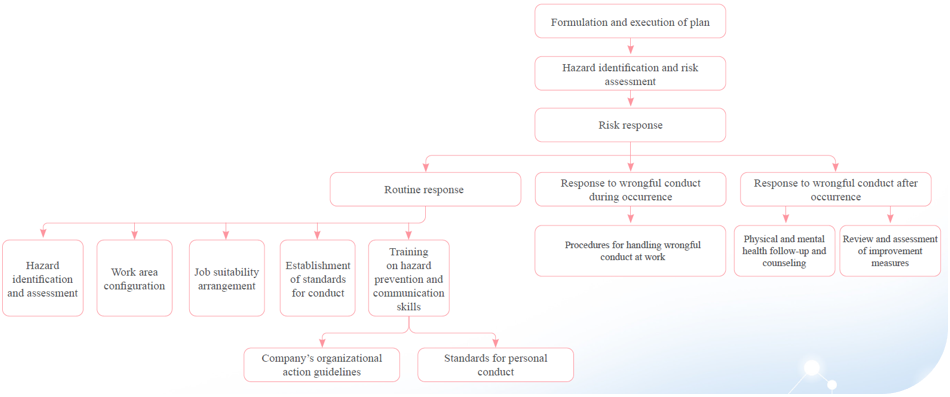
To prevent employees from unlawful infringement while performing their duties in the workplace by supervisors, colleagues, service recipients, or other third parties, the Company has established a Prevention Plan for Unlawful Infringement During Duty Performance.
In 2025, quarterly awareness campaigns on “the Zero Tolerance Statement on Workplace Violence” were conducted on February 5, May 5, August 5, and November 5, reaching a total of 433 participants. The Company also organized educational training sessions on “Prevention of Workplace Sexual Harassment” and “Other Unlawful Infringements”, with 342 participations. In addition, “the Self-Assessment Checklist “for “Workplace Unlawful Infringement” was implemented to strengthen preventive mechanisms and workplace safety.
The following outlines the Company’s procedures for handling wrongful conduct at work:
Salary and Remuneration of Employee
Remuneration Policy
【Articles of Incorporation】
Pursuant to the Company’s Articles of Incorporation, a certain percentage of the Company’s annual earnings shall be allocated as employee compensation, of which no less than ten percent (10%) shall be distributed to its non-executive employees. However, the Company’s accumulated losses shall first be offset.
The employee compensation may be distributed in cash or stock, and the recipients may include employees of the Company’s subsidiaries who meet the applicable eligibility requirements. The distribution of employee compensation, including the allocation ratio for non-executive employees, shall be reviewed by the Compensation Committee, approved by the Board of Directors, and reported to the shareholders.
【Compensation Policy for Non-Executive Employees and the Actual Allocation Status】
The Company’s total year-end bonus distributed over the past three years has ranged between 3% and 7% of its annual profit before tax. Bonuses are granted based on performance evaluation criteria to motivate all employees to work collectively toward the Company’s goals. For the year-end bonuses distributed in January 2025 for fiscal year 2024, more than 50% of the total bonus amount was allocated to non-executive employees.
In addition, employee compensation is distributed in accordance with the Company’s Articles of Incorporation, which require that not less than one percent (1%) and not more than ten percent (10%) of the Company’s annual earnings be allocated as employee compensation. Not less than ten percent (10%) of such employee compensation shall be distributed to non-executive employees. The Company’s Board of Directors resolved the employee compensation for fiscal year 2024 on March 6, 2025. The employee compensation actually distributed in June 2025 amounted to approximately three percent (3%) of the Company’s annual earnings, of which around thirty percent (30%) was allocated to non-executive employees.
Performance Management
Work goal setting, management and assessment basis
- ◆ Semi-annual action plan formulation (project work and routine affairs)
- ◆ Weekly, monthly and quarterly work progress management and tracking
- ◆ Semi-annual work review form review score
- ◆ Execution of annual appraisal
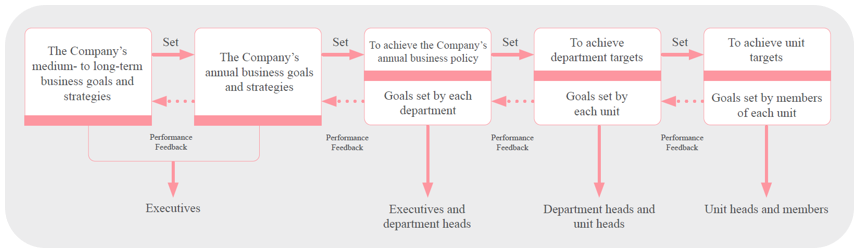
Goal setting process: Top→Down
- ◆ In order to achieve the KPI of the enterprise, there is an action plan for the department/job, which is implemented by each unit
- ◆ Everyone's job role contributes to the achievement of corporate goals
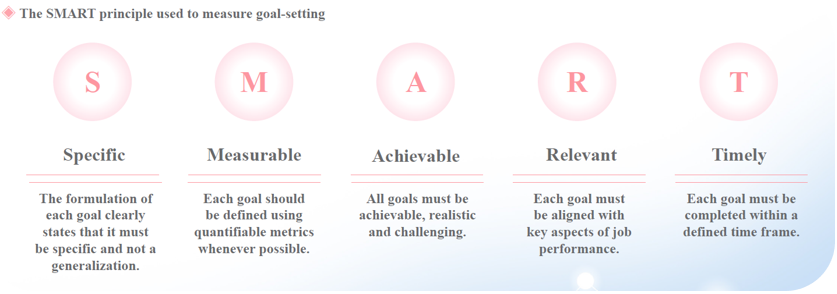
Metrics should be set according to the "SMART" principle
- S —Specific
The formulation of each goal clearly states that it must be specific and not a generalization. - M—Measurable
Each objective should be set with quantitative indicators as far as possible. - A—Achievable
All goals must be achievable, realistic and challenging. - R—Relevant
Each objective must relate to the focus of job performance. - T—Timely
Each goal must be completed within a limited time.
Salary Structure and Operating performance reflects the implementation of employee remuneration policies
The Company sets the compensation system according to the characteristics of the industry, market conditions and future development. We also provide appropriate incentives according to the achievement of the company's operational goals and the performance assessment results of departments and employees in order to motivate our employees to jointly create operational performance and long-term value with the Company and to realize our establishment purpose, vision and mission and sustainable management.
1. Establishment of the Remuneration Committee
It is responsible for the policy, system, standard and structure of salary and compensation. The salary standard is in accordance with the classification of the position. The salary, license allowance, and promotion of positions shall not discriminate on the basis of gender, age, race, nationality, and other factors.
2. Salary Structure
- (1) Monthly salary: Applicants' expectations and salary market conditions must meet the salary standards for graded positions. Job salary, additional license, expiry of probationary period, and job promotion.
- (2) Bonuses: monthly or quarterly operating bonuses, year-end bonuses, employee remuneration distribution, project/incentive bonuses
- (3) Year-end bonus:
- The total year-end bonuses from 2022 to 2024 were between 3% and 7% of the current year's pre-tax profit and loss, and are issued according to the assessment standards.
- Assessment standard: 4 (level) = excellent; 3 (level) = good; 2 (level) = good, for the standard, most of them; 1 (level) = those who have not reached the probationary period or the performance is not as expected or otherwise special Considerer; 0 (grade) = poor (end of year not given).
- (4) Employee compensation: The Company's Articles of Incorporation provide that the Company shall distribute employee compensation at a rate of 1% to 10% of the current year's profits.
3. Performance evaluation
Performance evaluation shall be carried out twice a year, and the evaluation results shall be used as the basis for promotion, salary adjustment, bonus payment and compensation payment.
Fair pay
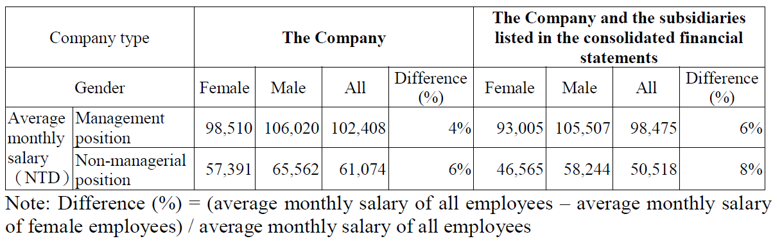
The company is committed to implementing an equal and friendly workplace. The overall salary is better than that of OTC biotechnology and medical companies, and does not differ due to factors such as gender, age, race, nationality, place of birth and disability, so that employees can develop their personal value in an equal workplace environment. And contribute to the director.
The Company is committed to providing an equal and friendly workplace. Taking non-management positions in Taiwan as an example, the average monthly salary in 2024 was 2.2 times the basic salary (the monthly basic salary in Taiwan in 2024 was NT$27,470); it was 2.4 times for men and 2.1 times for women, regardless of gender, age, race, nationality , place of birth, disability and other factors.